Riot roots and riot branches

One

I was slouched outside Hastings Magistrates’ Court, reporter’s notebook in hand, when I saw a kid I knew. He was a foster child who lived with the family of one of my friends. He was 16, but looked younger. Last time I’d seen him we’d been fooling about at a party, enjoying the traditional manly pleasures of the belly-slap and rough-and-tumble.

‘Hello, Rich!’ he said brightly.
‘Alright, mate!’ I rejoined.
‘What you here for?’
‘Reporting. Nothing special. You?’
‘I smashed this bloke’s window.’
‘Why did you do that?’
‘I was walking past and he was looking at my girlfriend. So I smashed his window.’
He showed me the cuts he had on his wrist from the incident.
‘Oh, mate,’ I said with a sigh. ‘You shouldn’t’ve done that. You know that, don’t you?’
‘I know, Rich. But I just don’t give a fuck.’

Two

I’m on a team away day at Recipease, Jamie Oliver’s horribly punning shop/eatery/cookery establishment in Clapham Junction. We are there to be taught how to make spinach and ricotta tortellini by a Jamie-approved cheeky-chappy Irishman. He suggests that before we start cooking, we have a look at some of the great food and cookery items on sale, some at a discount.

Wine is brought and we sit and have a glass at rustic tables, where Jamie’s books are casually placed.

‘This is nice,’ says someone.
‘This is nice,’ says another.
‘This is nice,’ says a manager.
‘This is revolting,’ I think.

I wander around this suffocatingly-branded heaven and stroll to the front of the shop, where I look out and see a Starbucks and a Waitrose. A familiar feeling of hate and self-loathing rises up inside.
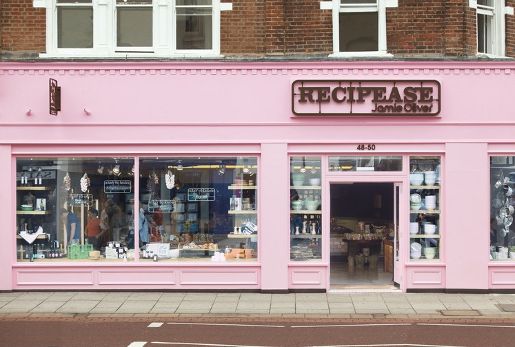
Did Jamie Oliver's Recipease eatery inspire the disenfranchised youth of Clapham Junction to riot?

Three

Hastings Magistrates’ Court. I’ve been in a session, hearing a 14-year-old boy get sentenced after breaking the terms of his Asbo. He’d stolen a car, gone for a ride and crashed into a wall, seriously injuring himself and two of his mates.

In normal youth court you are not allowed to name the youth involved in order to protect the child’s identity. But for Asbos, publicity is part of the deal, even for kids. Name and shame. Teach them a lesson. A nice front page lead for Purnell.

I strolled out of the court, and get stopped by a small kid with a lot of gel in his manky hair.

‘Were you in court?’
‘Yes.’
‘What did Jake get?’
’22 weeks.’
’22 weeks.’ he paused for thought. ‘What’s that? Five months. He’ll do half, be out in two-and-a-half. Not bad.’
We shake hands and he gets on his mobile to excitably tell his mates the verdict.

Four

I’m at a friend’s party in Battersea. We used to be reporters together in Hastings. Now we are in London and it feels good to have that connection with my recent past.

However, we are on slightly different social strata. I went to comprehensive school; she went to public school. I went to Leicester University; she went to Bristol. I’m living with a journalist who works at the Daily Express; she’s living with a journalist who works at the Daily Telegraph.

As soon as I arrive the necessary and sufficient questions are asked by smirking, chino-wearing men.

‘Where do you work?’
‘What university did you go to?’

They know, instinctively, that I did not go to Oxford or Cambridge or Bristol. They know I am not earning as much as them. Still, they like to have the point underlined, just to be sure, just for fun.

Once they’ve established I am not worth talking to, they ignore me. I’m left on my own, telling myself not to do something bad, so I don’t embarrass my friend. I drink punch and pretend to be interested in the DVD collection, wondering when it would be polite to leave.

Eventually another girl from Hastings arrives. We spend the rest of the evening on our own, out on the balcony, happy in our lower-middle-class ghetto.

Five

Monday 8 August 2011. I am walking through Brixton. Police are everywhere. The town centre is blocked, the tube station closed, so I get on a bus. When I see the devastation, I think: good.

A suit on my bus, shocked to the core, takes a picture of a smashed-up bus stop on his iPhone. I think: prick.

Tuesday night, 8pm. I catch a bus from Brixton. Everything is shut, even the fried chicken shops. On the bus I see men outside blocks of flats, having a beer, having a smoke, making sure.

Wednesday. Laura from the Ritzy emails, saying they are back open and can I host the open mic tonight? I tell her it is folly – none of my nice audience will show up so soon after the riots.
‘Let’s do it anyway,’ she says.

I get down there after work, heavy of heart, angry at everything and nothing. I stick Dexy’s Midnight Runners on. If it’s the early ’80s all over again, may as well do the job properly.

Laura greets me on arrival, says two Brazilian dancing girls have been in touch. Is it okay if they perform?

Well…all right.

A soul singer arrives and we get chatting about the early years of Mariah Carey, a subject on which I speak very impressively. A couple of kooks arrive to play blues, a shabby spoken word artist arrives, a comedian, an Asian singer whose been before.

We get going. I do a poem about Hastings, about those early days when I was happy getting paid £10,000 a year to report on the lower echelons of our finely stratified society. People are listening, small smiles of recognition on some of the faces.

Our soul singer opens. Turns out she’s good, really good. Everyone is performing well, everyone is happy, and those layers of hate and loathing start to peel off of me.

We take a break and I clear the stage for the dancing girls. I get everyone – even those cool people in fine clothes looking thoughtful over laptops – upstairs to watch.

Then, when the place is full, and buzzing, I get the soca rhythms on, make the introductions and the dancing girls, wearing full carnival costume, by which I mean virtually nothing except a lot of make-up and enormous, brilliant head-dresses, and the clapping and dancing begins as they shake and dance with visceral energy, shaking and bouncing, head-dresses brushing the ceiling, men drinking beers quickly to hide their feelings, and it is a party, a party, reminiscent of Rio, reminiscent of Brixton on any particular evening. Seventy-two hours after the riots, everything is forgotten.


We’ve all been screwed

Yeah, great news today. Really great news. Amazing news.

The UK’s biggest-selling newspaper has been shut down. 200 journalists are out of work. A dying industry is shoved nearer to the grave.

So, great news.

You know things are going badly wrong when Max Mosley is all over the TV, crowing. And Hugh Grant. Even Ed Milliband had the confidence to come out and say something vaguely approaching an opinion. (He thinks someone did something wrong. Possibly.)

The News of the World did some bad stuff. Okay. If Andy Coulson needs to get dragged through the streets of London tied to the back of Hackney cab, then hung, drawn and quartered, his head put on spike as a warning to hacks, I’m cool with that.

But the killing off of a newspaper, a don’t give a fuck, punk rock, let’s have a go at the bastards newspaper that skewered the reputations of, off the top of my head, Max Mosley, Boris Johnson, John Higgins, Fergie, Sven, Pakistan cricket and Paul Burrell. I am not cool with that.

The Screws brought you this stuff, with gusto, on a Sunday, when you’ve got a hangover and are loading up on carbs and fats at the breakfast table.

All the folk reading the broadsheets got the story a day later, rehashed from the original with a few literary allusions thrown in to shine the shit their readers could not bear to read from the original source.

What the Screws delivered was what the British public, minus the hacking into dead children’s phones, wants. And how do I know? Because over one in ten people in this country read the thing. How many read the Observer? No one, apart from a few in Stoke Newington, and some old lefties in nursing homes.

I can’t help feeling all of those who are really happy about the demise of the News of the World fit into one of three categories:

1. Those who have genuinely suffered at the hands of the Coulson / Wade axis.
2. Those who still hold a grudge against Murdoch for what happened with the printers’ unions back in the 1980s.
3. Ignoramuses who understand nothing about the value of a free Press pursuing a story in the public interest (or just because it is a bloody good story).

I don’t think Nick Davies, the fabulous journalist who has pursued this story for years in the Guardian, can be happy about the Screws being closed down. He wants good journalism, campaigning journalism. Coulson’s head on a stick, for sure.

But if genuinely terrible people like Max Mosley and Hugh Grant get their way, this could lead to a shackled Press, fearful of pursuing stories because of the possible comeback. That no journalist would want.

I used to be a journalist, on a local paper. I’ve found that anyone who has been a journo for any length of time is essentially of the same breed. Nosey, gossipy, sweary, interested in asking questions for the sake of it, interested in stories for the love of it. Totally unable to work unless there is a looming deadline, a malevolent editor hoving into view.

I always knew, as a reporter, that people did not trust you. They thought you cynical and dirty. Then, much more often than not, told you everything you needed to write a good page lead. And loved that little bit of publicity for themselves.

The first principle of journalism is that bad news is good news. If there is a murder, let it be a crazed swordsman slaying a blonde virgin. If there is a road crash, let it be at high-speed with students, gifted and talented students, out of their minds on meth. If there is a scandal, the more intricate, the more high profile, the more you are able to milk it, the better.

The bitter irony for all journalists, and anyone interested in a free Press, is that the closing of the News of the World is a really, really good story. Perhaps the best story we will have for a long, long time.

Sneering and sanctimonious: Purnell in Ireland

“Hello, my name’s Paddy,” said the Irish B&B owner.
“Of course it is,” says I.
“You’ll have to speak up. I’m as deaf as a post.”
“I said, ‘my name’s Richard.'”

Yes, I find myself in Ireland, the former English colony where Cromwell set about the locals with unparalleled gusto. And perhaps it is that historical echo which brings out my sanctimonious sense of superiority over the Irish. Or perhaps I’m just a twat. Hard to tell.

I came here through the sort of negative decision making which typifies my approach to holidaymaking. I wanted to go to Scotland but discovered a train to Fort William was £140. I then noticed a flight to Cork was £35, so went to Ireland instead.

People always say that Ireland is a very welcoming country. That is true. And I suppose if you’ve had as much money off the EU and IMF as Ireland has over the years, you’d be welcoming too.

Signs of the subsidy and loans goldrush, now dried up, are everywhere to be seen. The airport is a swanky glass and steel affair, opened four years ago. The city’s municipal buildings are the same way. New and shiny. Bought, but not paid for.

Bought but not paid for: Cork's magnificent airport

It was no surprise, therefore, that the main news story here is that the Irish government is trying to wriggle out of paying back the £3.5 billion loan from the IMF. Now is probably a good time to ask. With Greece rapidly descending into anarchy, the IMF may think it wise to burn the Irish debt to stop it going the same way.

—-

I am magnificently unprepared for life in Ireland. I have arrived with no jacket, and no brolly either. And Cork, as most people know, has but two types of weather: drizzle, and heavy rain.

So, with nothing more than a purple v-neck sweater on my back (H&M, £19.99) I find myself wandering the streets, diving under awnings when the rain gets fierce. It was through this method that I entered, dripping wet, the local art gallery.

The Crawford Art Gallery has the standard, winning combination of abstract paintings, religious art and pictures of rich locals from the 18th century. Beyond all this, on the second floor, you find that scourge of galleries everywhere: the video art installation. (I don’t know who decided galleries must display this crap, but could they please reverse the edict?)

This particular video was by Grace Weir, a sort of one-woman argument against state subsidy of the arts. By unhappy coincidence, I had seen this film, In My Own Time, at the Science Museum when I worked there a few years ago. Grace Weir is Irish so I suppose it is only right that her countrymen should suffer her videos, too.

In My Own Time is one of those works which should only be viewed if it is pissing down outside, and there is nothing else to do. On that basis, I ambled in.

I remembered two things about this film:
1. It is impossible to sit through.
2. It is impossible to sit through because it has a cow-milking scene in it.

This cow-milking scene isn’t, of itself, offensive. I like a drop of milk and so it would be folly to object to seeing the process in action. But in this film it comes after 15 minutes of Grace and her black rollneck-wearing accomplice dicking about with mirrors while she prattles on about time, thoughts lifted, no doubt, from back issues of the New Scientist (that’s how she wangled the Science Museum commission).

With that dreadful prelude, when the cow-milking scene arrives, even the most hardened gallery-goer begins to suspect he or she is the victim of a practical joke. Disgusted, the viewer cuts their losses and clears out of the gallery, vowing never to watch video art again.

Which is exactly what the other person in the gallery did. I, however, through a combination of masochism and lack of brolly, stayed until the bitter end. I would have become the only person to have watched the film in full, apart from the fact that I’d arrived a shade late and missed the first few minutes.

When the film was over it was drizzling lightly, and I went for a Guinness. While supping the black stuff, I came up with this rather context-specific joke:

Q: Is Guinness good for you?
A: No, of course it’s not. Like all booze, it can give you all sorts of nasty killer diseases, but in comparison to Grace Weir’s art it is the elixir of life itself.

Guinness: good for you if you want an early grave

Imogen Thomas: Defoe and Messi to the rescue!

As the world celebrates the stupendous footballing skills of one short man, Lionel Messi (5ft 7ins), we should also rejoice at the tireless off-field work of another pint-sized footballer.

I am referring to the great Jermain Defoe (5ft 7ins), of Tottenham and England, who, as revealed in today’s News of the World, has not taken the conclusion of the Premier League season as cue to put his feet up.

Showing a Victorian morality and work ethic, Defoe has moved from his day job as goalscorer to concentrate on philanthropy in the summer months. The chief beneficiary of this big-hearted generosity is former Big Brother starlet and model Imogen Thomas.

Following her romance with hated Manchester United star Ryan Giggs, she naturally thought the right course of action was to tell all in a tabloid newspaper. Giggs, who has carefully crafted a family man image despite his rampant sexual antics outside of his marriage, callously demanded a superinjunction to deny Imogen her basic human rights: a well remunerated kiss ‘n’ tell.

How on earth did she cope?

It is revealed that her ‘rock’ throughout this trauma was our hero, Jermain Defoe. Showing class which Giggs could never possess, he sent her supportive texts, provided a shoulder to cry on and offered the occasional tryst. (They have form: he shagged her for a few weeks during his annus mirabilis, 2009, when he returned to Tottenham from Porstsmouth, scoring lots of goals and working his way through just about every fame-hungry bird in old London town.)

Gallant, noble and chivalrous: Jermain Defoe gives Imogen Thomas the oxygen of publicity

Despite splitting up from her because she asked him to pay for a new boob job, Defoe has gallantly rekindled their romance to help her remain in the public eye following the Giggs affair. She knows she can trust him completely. There is no way that he would ever dream of taking out a superinjunction against any woman whom he had loved, for one night or several. He knows that kiss ‘n’ tells can only burnish his image as a modern-day Casanova. He understands implicitly the need for a certain kind of woman to tell all, with help from Max Clifford.

I have long noted that Defoe is at his best shooting form on the football field when he is scoring prolifically off it. He did suffer something of a difficult season, scoring only nine goals. I feel confident that his liaison with Imogen can help him get back to his best.

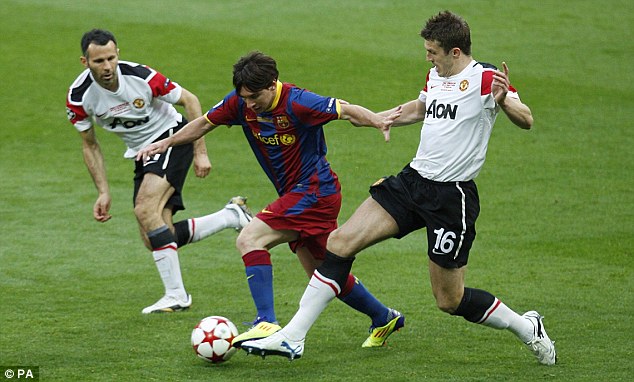
It does seem as if the football season has concluded in exactly the right way. Lionel Messi has won the Champions’ League, once again underlining the pre-eminence of the short man in football. No doubt aware of the Imogen Thomas scandal, Messi made sure Ryan Giggs was utterly humiliated. Giggs can now spend the summer in his high-security Welsh fortress, with his wife and kids, reflecting on his many and various crimes.

Jermain Defoe and Imogen Thomas are no doubt already planning a long break on Caribbean beaches, with the paparazzi in tow, as they and the tabloid newspapers assert their right to titillate the public as we wait for the 2011/12 season to begin.

That's for Imogen! Messi humiliates Giggs

Why a Kindle is not for me


I was recently in the British Heart Foundation shop in Brixton with my friends Shonagh and Alex. They were buying a sofa bed, and were spending an age getting it measured, looking at the price, wondering whether it was too much, and generally procrastinating in fine Sunday shopping style.

After a while I became tired of this charming scene, and wandered off to the records and the books. Flicking through the vinyl, I picked up some absolute crackers: a 12-inch single of ‘Let the Music Play’ by Shannon, and a Boney M album.

Holding an armful of vinyl,  I ambled over to the bookshelves and saw a nice volume, entitled Modern Short Stories, on Faber. This had a few old favourites in it: Dylan Thomas, F Scott Fitzgerald, Ernest Hemingway, and other worthies whom I’d never read. It was a pound, so I bought it before rejoining my friends at the sofa bed.

When I got home, I read the F Scott Fitzgerald like a greedy child eats ice cream. Having sated my Fitzgerald craving, I settled into a more relaxed perusal of the contents. On the inside cover I noticed a name and year written: Gordon Smith, 1987-88. There was also a stuck down sheet, torn so it only said, ‘The Edinburgh…’ So, this was a school book. Perhaps something to be read at ‘O’ level, as it would have been then.

Flicking through, on p41 young Gordon had written ‘I want to die!’ My heart went out to him, all teenage and Scottish back in the late ‘80s. What could have caused him to despair so?
 
It may have had something to do with the story on which this plaintive statement was written: ‘My First Ball’ by Katherine Mansfield. It appeared that Mansfield’s prose style was not appealing to Gordon. I imagined him there, sitting at his desk in an austere Edinburgh classroom. All he wanted to do was get out and listen to the Proclaimers on his Walkman, but instead he was forced to read about some girl going to her first ball.
 

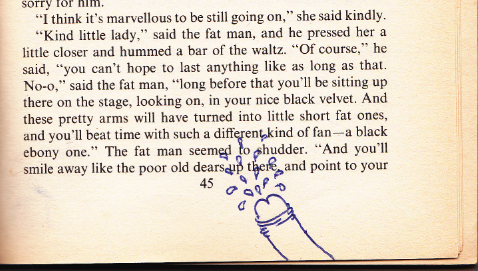
I turned the page and found that Gordon’s spirits had returned somewhat. He had defiantly drawn a dick and balls. This took me back to my own school days. I remembered a period of about a year, at the age of twelve or thirteen, when the first pubes are growing (or perhaps not quite) and all a boy can draw is the dick and balls. However, Gordon had gone further. No doubt feeling insulted to have been made to read Katherine Mansfield’s girly nonsense, he drew a shower of piss coming out of the dick.

Yes, that’s right, Katherine Mansfield! Gordon Smith is pissing on your prose. Pissing all over your silly story. Gordon Smith doesn’t care about Leila or her first ball! Doesn’t give a damn about it! He’s got a great shower of urine cascading over your turn-of-the-century vignette!

A fine example of the 'dick and balls' school of art

On the following page (I had almost totally lost interest in the actual story by that stage) Gordon returned to his artistic theme. But this time he had drawn just a dick, arising mischievously from the bottom of the page. He’d arguably done a better job here, with detail to suggest the foreskin, and a more mature shower of piss.

Gordon made no further artistic additions to Modern Short Stories, clearly feeling his work had been done. He had survived the Mansfield ordeal, and was possibly stronger for the experience.

What path that book took from the Edinburgh classroom to the Brixton charity shop we will never know.  What I do know is that I felt a gentle thrill from having held the book that provoked such despair and defiance from a Scottish schoolboy.

It also made me realise why I will never get a Kindle. Books are more than words on a page. They are things to be loved and hated and, if necessary, drawn upon. This was an experience I could never have had with a Kindle. Books develop a character over the years whereas a digital file will always remain useful, convenient, but ultimately impersonal.

Thank you to Gordon Smith, and indeed Katherine Mansfield, for reminding me that books, quaint though they might be, remain things to be treasured.

Showing greater artistic maturity: G. Smith's 'dick with piss'

Tonight Grassy Noel saved my life

So, I died on stage tonight. That was to be expected, considering I was reading poetry in the public bar of a Brixton pub.

People were coming in. Saying hello to friends. Ordering drinks. Going for a piss. Whatever.

What they were not doing was listening to my tender words. It’s hard to keep going when only the promoter of the night, the estimable Dennis Just Dennis, is watching you. No one else, not even your mates, could give a shit.

Up there on stage, without some sort of human response, you have that feeling perhaps akin to being in purgatory. Someone is going to send you to hell in a minute, but not before they smoke a rollie out back in the beer garden.

It was a truly horrible experience. It wasn’t Dennis’s fault. He usually has the room upstairs, where people are up there if they want to be there. But tonight, there was some sort of party and we got moved to the public bar.

Dennis put a positive spin on it. ‘It’s a chance to get people from off the street, win over the crowd down here.’ He and I knew that was small talk. It was going to be a hard night.

After I’d done my slot, I fucked off to the back of the bar and drank Guinness for a bit.

But then Paul Birtill was on. He is one of my favourite poets. A scouser living down south. Bone dry wit. Micro-poems. The kind of poetry I’d never produce but love to hear.

I encourage my mates to come up the front and listen to the man. He reeled off his set, battling against the woman with the machine gun laugh at the back of the bar.

He got some laughs. Less than usual, but still, he’s a pro. He did well. Much better than me.

Then it was time for a break and after that was Grassy Noel and his band, Ape. Grassy had witnessed proceedings, sipping orange juice in the wings (he’s teetotal).

His band I had seen at Kid, I wrote back. They were absolutely incredible, and went down a storm.

This time, Grassy, in trademark black trilby and black jacket, was in full attack mode. I liked to think that he’d seen the way his fellow poets had suffered up on stage, and with his band behind him, was meting out some justice.

He started off not using words. Just noises, bellowed into the mike. It wasn’t pretty, but it was pretty effective. Quite a few people left the bar.

The band started firing up, the stand-up double-bass with bulldog clip on the strings, the better for producing harsh clipped basslines. One of his colleagues was playing the vuvuzela, the instrument of choice at the last World Cup in South Africa. The other fellow was producing strange sounds from a lap top.

And then Grassy started naming wartorn countries. Libya…Afghanistan…Pakistan. For ages, not looking at the crowd, down in the microphone, juddering, shuddering.

Then he got onto Humpty Dumpty, in his preacher-like Irish tones, got down, deep down into the nursery rhyme, which, by christ, has never sounded more sinister.

Humpty Dumpty had a great fall…Humpty Dumpty had a great fall…

One of the band started clanging two ancient fire extinguishers together.

More people left. Beer garden, out front, whatever. Just out. Fucking brilliant.

His band got the horns out, the cornet and the alto sax. This is where they sound all Radiohead, in the Amnesiac era. Freaky as fuck. Really really good.

Now Grassy’s going on about the Seventh Seal. Who know what he’s talking about, but it’s dark. Dark and incomprehensible. But I understand. This is punk. This is brutal attack music and poetry. This is living without compromise. This is G-Force poetry. If My Bloody Valentine did poetry, it would sound like this.

By the end of the set, it was just me, my two friends, Dennis, a few more freaks, and the band. Everyone had wisely got the fuck out.

People have the right to enjoy a drink without being assaulted by poetry. And poets have the right to bring their words into pubs and carry out assaults. Everyone is right. And not everyone can be happy all the time.

I died on stage tonight. And tonight Grassy Noel saved my life.

Justice 4 Ashley

In this video, I make an impassioned defence of the human rights of Chelsea and England footballer, Ashley Cole. My speech, while being rather rambling, covers off most of the salient criticisms made of this most misunderstood of Premier League stars – the move from Arsenal to Chelsea, the lovemaking, the gun incident.

Please do watch and let me know what you think. I want to hear all sides of this most pertinent debate. However, ultimately, what I am looking for is greater tolerance and understanding of our well-paid footballers, particularly Ashley.

There were, however, some remarkably arguments in opposition to Ashley. This video below shows how it is only through going out into the community and talking to people face to face that you really get to understand where some of this dislike stems from