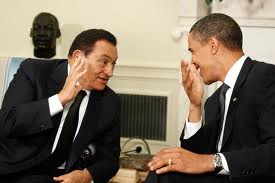
President Mubarak has gone, despite the very generous $1.5 billion each year he received from the US to keep his people in the state to which they had become accustomed. Throughout the 18 days of protests the west remained unwilling to speak out too strongly against their friend and ally. Like Pinochet, he was a man with whom the west could conduct business.
So here is a poem in honour of
A good despot
People called him a dictator, a tyrant, a despot
I say: that is not the man I know
I know a man of learning, culture, principles
And say this world must have gone mad when
A man, a military man, can give 60 years
Of unswerving service to his nation
And be treated like a common or garden criminal
It was laughable to me, seeing those unwashed beasts
filling the streets with their tatty flags and odours –
Couldn’t you almost smell them through the flat screen tv? –
Bearing their rotting cavitied teeth,
and demanding, what? Some kind of idiot justice
and an end to the rule of a man, a friend to the west
A man who had done his duty and his exceptional best
They said he had feathered his nest a little bit
Well, did he not deserve that for playing such a
calm, considered role in the realm of geopolitics?
We are not talking about anything insidious,
We are talking about a man who
was steadfast in doing the right thing,
A man whose farthest thought was abandoning ship
He has gone now, sating the shameful need of
A nation’s children to be rid of their grandfather.
The next days will be hard, yet I feel sure
he will be wise enough to reflect that
He is merely the latest in a line of great leaders
who leave power quietly admired by the many
while loudly decried by the hotheaded few
Michael Lewis, author of The Big Short: Inside the Doomsday Machine, was in converation at a free LSE lecture tonight. He confirmed that the book, about the collapse of the sub-prime mortgage market, and subsequent spectacular fallout, had been bought by Brad Pitt and Paramount Pictures.
He also said that Brad Pitt would star in the film as Steve Eisman, a hedge fund manager who made millions by betting against the subprime market.
Lewis, in his usual irreverent style, described Eisman as a guy who ‘gets pleasure out of saying things that are true and offensive, like a really bright four-year-old on steroids.’
Eisman’s wife says of him in the book, ‘Even on Wall Street people think he is rude and obnoxious and offensive.’
So it looks Pitt should have a lot of fun playing this character, and we should have a lot of fun watching him when the film comes out.
Lewis had a host of great throwaway quotes at LSE:
“People have unreliable memories, especially about their own financial decisions.”
He pointed out the most of the characters in the book are reprehensible in many respects. About Greg Lippmann, who had shorted the market at Deutsche Bank: “Even when he is saying a profound truth he can seem like he is lying.”
About the bond traders: “None of them thought they had made bad decisions. They thought they were victims of a natural disaster…they were not good witnesses. They hadn’t understood what was happening to them when it was happening to them.”
He also told a terrific story about his own LSE days when the students used the sport budget to buy a racehorse. Upshot was the racehorse wasn’t very good and some people weren’t happy so the sport budget was instead spent on sending folk like Lewis around Europe to play basketball.
Lewis described LSE students in the early 1980s as ‘the most irresponsible people I’ve met, including sub-prime mortgage traders.’
He also showed himself to be a master of the Q&A, using all of the questions as an opportunity to pull out more from his seemingly endless supply of stories.
And finally he gave this wonderful insight into his writing style and indeed good writing generally: “The trick is to leave a hole in the story to allow the reader in and let them exercise judgement.”
My dad was given the Mark Twain autobiography for Christmas. Great big thing, about a thousand pages long, of such formidable size you could never get it on the tube or bus. It’s the kind of awesome volume which you can only read if you are a scholar, or retired. I am neither; fortunately CW Purnell is both. Happily he has pulled out some of the juiciest quotes from the first third of the book from the inestimable writer of Huckleberry Finn.
So, in page order, here they are. Thanks daddio. For all Twain fans – enjoy!
Selected quotations from Mark Twain’s Autobiography
On James W Paige, a failed businessman who cost Twain $170,000 (p102)
(He) is a most extraordinary compound of business thrift and commercial insanity; of cold calculation and jejune sentimentality; of veracity and falsehood; of fidelity and treachery; of pluck and cowardice; of wasteful liberality and pitiful stinginess; of solid sense and weltering moonshine; of towering genius and trivial ambitions; of merciful bowels and a petrified heart; of colossal vanity and – but there the opposites stop. His vanity stands alone, sky piercing as an Egyptian monolith.
On Countess Massiglia, landlady of Villa di Quarto (p241)
She is excitable, malicious, malignant, vengeful, unforgiving, selfish, stingy, avaricious, coarse, vulgar, profane, obscene, a furious blusterer on the outside and at heart a coward. Her lips are familiar with lies, deceptions, swindles and treacheries as are her nostrils with breath.
On his discussion club (p273)
The Club was founded by a great clergyman: it always had more clergymen in it than good people.
Twain’s quote from Bill Nye about Wagner (p288)
I have been told that Wagner’s music is better than it sounds.
On Duelling (p294)
In those early days duelling suddenly became a fashion in the new Territory of Nevada and by 1864 everybody was anxious to have a chance in the new sport, mainly for the reason that he was not able to thoroughly respect himself so long as he had not killed or crippled somebody in a duel or been killed or crippled in one himself… I was ambitious in several ways, but I had entirely escaped the seductions of that particular craze. I had no desire to fight a duel; I had no intention of provoking one. I did not feel respectable, but I got certain amount of satisfaction out of feeling safe.
The Character of Man (p312)
… of all the creatures that were made he is the most detestable. Of the entire brood he is the only one – the solitary one – that possesses malice. That is the basest of all instincts, passions, vices – the most hateful. That one thing puts him below rats, the grubs, the trichinae. He is the only creature that inflicts pain for sport, knowing it to be pain…. All creatures kill… but of the whole list, man is the only one that kills in malice, the only one that kills for revenge.
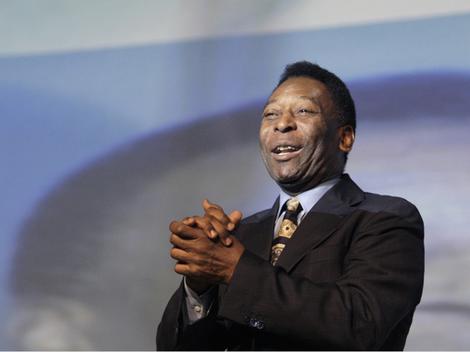
You know the debate about the future of the Olympic stadium at Stratford has become farcical when Pele starts piping up with his opinion.
Pele is the most notoriously wrongheaded pundit in football (I know, a bold claim, but one he comfortably justifies). This is the fellow who said that Nicky Butt was the future of football, as he did about Freddy Adu, the wonderkind who flopped hopelessly from that moment on. He also declared Totti the best player in the world, which might be true if you were judging him on his hair and overlook that he always goes missing in big games.
It’s true, Pele was good at scoring goals. He is also a geriatric loudmouth who should, as Maradona so wisely put it, ‘go back to the museum.’
An irritating old man who used to be good at football
Now, possibly guided by a conversation with that impartial and sober judge, Jimmy Greaves, he has been led to think that Tottenham are the rightful inheritors of the Olympic stadium. That’s the proposal, you will remember, to rebuild the stadium for football with no running track. Which is perhaps not quite what the British public thought the Olympic legacy would look like. This is in opposition to West Ham’s proposal to move in, retaining the track.
So what is the right decision?
I’ll admit, it’s a tough one. On the upside, if Tottenham get the stadium it would leave their fans harrumphing about loss of identity and give opposition fans years of fun along the lines of ‘you’re just a shit club from Stratford,’ etc. It would leave West Ham fans feeling like they’ve been robbed, which is their natural state. It would also make Lord Coe a hate figure among athletes.
If West Ham get the stadium they will get a nice new home which is vaguely in the right part of town for them. However, the track would be retained, therefore robbing fans of their ability to intimidate opponents and linesmen. As a Rangers fan, I’ve long enjoyed abusing the lino, so I can feel the Hammers’ fan pain on this sensitive issue. When the super hoops are not having a good day, you can always amuse yourself by shouting at the linesman:
‘Oi, Lino. Dipstick!’
It’s part and parcel of the game, a tradition that has gone back generations, and one I would hate to see lost.
To make a proper judgement we must look at the wider ramifications. If Spurs get a bigger stadium it would give them greater income and secure their top five status. It would, therefore, leave Liverpool stranded in the longer-term as England’s sixth club (unless Sunderland or Villa are having a good year).
For me, the sound of the whinging scouser ringing up 606 saying this player or that player is ‘not fit to wear the shirt’ in that preposterously egotistical fashion the Reds fan has perfected is, in its way, rather endearing. It should be nurtured at every opportunity.
So, in summary, these, I feel, are the salient points to consider:
1. We must do everything we can to keep the scouser whinging
2. Upton Park should remain a haven for fans to abuse players and officials alike
3. West Ham fans should retain their sense of bad luck and injustice.
So, for the good of football, and it does pain me to say this: give the stadium to Spurs.
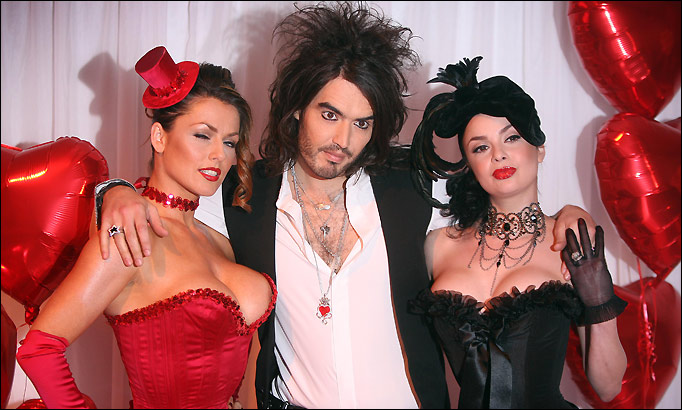
When I first saw Russell Brand on telly I thought he was an annoying twat.
There he was: all hair, eyeliner and belts, delivering a steady stream of innuendo-laden inanities.
My housemate at the time, Dan, put it succinctly:
‘I can’t stand that cunt,’ he said.
Dan didn’t just turn the channel over, he switched the tv off, as if to ward against Brand sneaking onto a different channel. I heartily agreed with this affirmative action. From there I cast aspersions against him at any opportunity without ever bothering to check if the fella was actually funny.
It was about this time that Russell Brand became ominpresent, what with his tv and radio shows, and daily appearances in the tabloid press. He even had a column in the sport section of the Guardian on a Saturday, and I went to great lengths to fold the newspaper in a way in which meant I could safely avoid looking at his odious fizzog.
However, there comes a time when a celebrity reaches a threshold of visibility when they simply cannot be avoided. Russell Brand, of course, achieved that point when he insulted Manuel on his radio show.
I hadn’t heard the broadcast but got the basics from the blanket media coverage seeping into my skull. I was coming home on the tube from a solid night’s boozing when my friend Alex asked me what I thought about the Brand controversy. I’m from Rainham, just a few miles away from Grays, where he’s from, so I was being consulted as a fellow Estuary Essexman.
‘I think he’s a disgrace to his county,’ I said vehemently, my views unbesmirched by any factual knowledge of the incident.
‘You can’t really think that, can you?’ said a bloke sitting opposite. ‘It’s all a storm being whipped up by the Daily Mail. It was just a joke that went wrong.’
‘I bloody well can think that. He’s a disgrace, going around abusing short men like that.’ (NB: I’m 5ft 4ins). ‘I’ve met people from Grays and he’s typical of the low-grade people you get there. He should be sent to Australia, I reckon.’
The bloke, a lily-livered liberal type, looked shaken. We glared at each other a bit, and then I got off at Victoria, and the matter was not further commented upon.
After that incident, I was intrigued enough to actually watch some footage of Brand doing stand-up on YouTube. He was okay. Not really laugh out loud funny, but intelligent, eloquent, and addictive to watch.
You could call Brand a lot of things, but you could never call him an attention-seeker
I was impressed by the fact that he had created a complete comic persona which allowed him to be confessional, surreal and a storyteller. And to pull vast hordes of women. He reminded me of my friend from school, Rob Howard, who could turn absolutely anything into innuendo, and had a sensational record with the ladies, too.
I loved the way that he cared about his audience. He managed to involve them, and allow them to share his pain and joy. That takes great skill and courage. To me, it was only moderately funny; but as a comedic journey towards truth it was brilliant. This is a man who truly knows himself and, like any great artist, can provide insights into our own lives.
A few months ago, I finally stumped up the money to buy Brand’s first autobiography, My Booky Wook. This was one of the best autobiographies I have ever read, and certainly the best modern memoir. He doesn’t allow himself to be anything less than totally honest, or totally funny.
This second book is clearly less well-written than the first installment. He’s run this off while he’s busy doing films and getting hitched to Katy Perry. So, he’s busy. Much of the text is cobbled together from his stand-up performances over the last few years, detailing appearances at various music award shows where like Ricky Gervais this week, he became notorious for telling mildly offensive jokes about famous people. Yet it says a lot for the quality of his lives shows that they stand up remarkably well when read off the page.
The original sections are mostly to the front of the book and this paragraph talking about how his pratfalls caused Kate Moss to dump him is typically briliant:
What no one realised, not Kate nor the red-top tabloid press, was that far from viewing her as a conquest, I was absolutely smitten. When I clumsily ballsed it up by flatly telling journalists who I’d not yet learned to ignore that I was ‘just larking around’, she wisely withdrew and I had enough sense to stop calling her. I didn’t delete her number from the phone though. I left it stored under ‘Grimy Tyke’, which is what I’d call her in an attempt to punctuate the endless flattery and awe.
And even when he’s got his hero, Morrissey, round at his house for filming, his mind is on other things:
Morrissey perused the house. I perused his make-up lady’s boobs; that is the miracle of big boobs, they remain interesting above all else.
This next sentence should go on his headstone:
I have stared over the shoulder of enlightenment to get a butcher’s at a cleavage.
His awareness of his own ludicrousness is what makes him so engaging. This second Booky Wook is the story of his escape from British TV and comedy, to superstardom. He’s made it. He’s got the pop star wife, the film career, and no doubt marvellous homes in LA and London. And even if he eventually loses touch with ordinary life in this country, it probably won’t matter, because as long as understands himself as acutely in the future as he does now, he’ll always be entertaining.
I was having a stroll yesterday, enjoying the sight of the fine people of south London attempting to slide down the newly-laid snow on the slopes of Streatham Common. The contraptions used were many and varied, from a fellow strapped onto a snowboard, to children on the classic sledge you see on Christmas cards. Most amusing, however, was a couple of middle-aged women going down the Rookery with Sainsbury’s carrier bags underneath their bottoms. Not the biggest surface on which to be sat, particularly when considering the scope of their back-sides, but they went down the slope at a decent clip nevertheless.
It was this sight that reminded me I was not far from the main Sainsbury’s in Streatham (there are another two, smaller stores farther along the High Road). As I had little to do with my afternoon, I though I would go in and buy some food. (Or ‘bob in for a few bits’ as my mother would have it.)
I’m a fairly loyal customer of Streatham Fruiterers, the greengrocers down near Streatham Hill Station, so I avoided the fruit and veg side of things. Ambling along, I found myself on the aisle with the breakfast cereals. Recently, I’ve moved towards Alpen as my cereal of choice. Seeking it out, I realised there was more work to be done in deciding which type of Alpen to buy.
There were three options:
a. Classic Alpen i.e. the normal one
b. High-fibre Alpen (with extra roughage for those who don’t shit as often as they would like)
c. Alpen, with no added sugar
All were £2.37, in same-size boxes. However, I noticed, with the alertness which rarely comes upon me in working hours, the Classic was 750g, while the other two were 560g.
I bridled at this. I am quite health-conscious, for two reasons: I want to live forever and enjoy being censorious about what other people eat. Therefore, I wanted the ‘no added sugar’ version. But, while I am health-conscious, I want good value. I envisaged buying the ‘no added sugar’ and finishing the box, knowing that if I had bought the Classic I would still have had another 190gs of the good stuff left. For once, my healthy lifestyle took second place to my parsimoniousness. I bought the Classic, yet felt like Sainsbury was making a mug of me.
Cantering about the store, I picked up some other essentials: pasta, bread, Bombay mix; at which point I realised I could have done with a basket. I am, if nothing else, efficient in my movements, and could not tolerate going back to the store entrance to pick one up. So I carried on, dropping the occasional item, picking it up, and dropping something else in the same motion. If Charlie Chaplin was there, doing his weekly shop, he would have thought it a bravura display of comic acting.
Having got my hands securely around all of my shopping, I came upon the herb shelf and realised I needed some dried oregano. I put my items on the floor, shoved the oregano in my jacket pocket, before going about the aforementioned picking up and dropping routine again.
Getting to the till, I unloaded the items on the conveyor belt, bar the oregano. I felt inside my pocket, and it was still there. While I paid for the vast majority of my items, the oregano stayed in my pocket.
Outside the store, I was so pleased with my work that I slid into the Pied Bull for a pint of Winter Warmer (£3.20). Ruminating about the matter, I saw clearly that Sainsbury could absorb the odd loss of oregano into its day-to-day running costs, with no harm to anyone. What’s more, becoming more reflective at about the half-pint mark, I realised this festive generosity on the part of Sainsbury had secured my custom for the New Year, however sneaky some of its pricing might be.
How big is Essex?
The map suggests it is bigger than Surrey
And not quite so big as Kent
And nowhere near as big as Sussex
When you join it up, the East and the West
Essex, I would contend, is bigger than any of them
Bigger, in fact, than all the counties put together
Bigger, while we’re at it, than all of Europe,
America, Africa and Asia
Colchester is far larger than Tokyo or Calcutta
The River Rom longer than the Rhone or the Volga
Epping more vaster than the forests of Sumatra
Harold Hill more higher than Mount Kilimanjarar
Yes, the map suggests Essex is bigger than Surrey
And not quite so big as Kent
I would say the man who did the map
got things wrong, out of perspective
And there’s one thing for certain
He weren’t born and bred Essex.
The office has been abuzz with talk of a new show on TV: namely, The Only Way is Essex. Some have said it’s so bad it’s good. Others contend that it is just bad. I was keen to find out.
I was reassured by the fact that the Essex show was on ITV2. This is my favourite channel, mainly because you can almost be guaranteed a bit of Katie and Peter action at any time of night or day.
You see, I don’t really like good telly. Give me one of those five-star rated dramas and I’ll be asleep within moments. It’s only the so-called shit telly that I can pay attention to. I can watch any amount of Snoop Dogg’s Fatherhood show, or At Home With the Kardashians.
So, to the show. At first sight it looks like a sort of Essex Hollyoaks, without a script. There’s lashings of fake tan, fake eyelashes, fake nails, fake acting. In fact, it might be nearer the mark to say it is more like an updated version of Eldorado, the ill-fated soap on in the early days of Channel 5.
But there has been some debate whether, aside from its lack of plot or characterisation or anything – does it represent an idealised Essex?
I reckon – and I may just be saying this because I’m from Essex and I’m narcissistic enough to write a blog – that it does. Essex, as Mark says, is a bubble. People in Essex have very little reason to leave and go elsewhere. I’m almost alone in my friends from school in actually having left the county. I’m not quite sure why I left: probably out of a desire to be curmudgeonly.
Also, this is a telly show that dares to have a sense of fun. It is rubbish on most normal levels, but it is almost impossible not to keep watching. I sat through two episodes this evening and was genuinely disappointed when it finished.
I think The Only Way is Essex is just like most things from Essex – a bit chintzy, a bit crap, but on the whole brilliant. I just hope Stacey Solomon makes a guest appearance.
What with all the anger surrounding the proposals to massively increase the cost of university education to students, it’s worth taking a look at who is behind them.
The man deemed by the coalition government to be best placed to ‘review’ the future of higher education is Lord Browne, John to his friends. This is the fella who was in charge of BP for many years until he got retired by the board.
Fortunately, for those of us who do not follow these matters closely, Tom Bower’s recent book, Squeeze, gives a decent summation of what Lord Browne is all about. He is described as the most rampantly aggressive pursuer of profits, even in the cutthroat world of oil. He’s the sort of neoconservative that makes George W Bush look like the epitome of restraint. And he’s a short man with one of those Napoleon complexes that makes you wonder if the term needs to be renamed. So, just the sort of balanced individual to take an impartial look at higher education.
For those who don’t want to wade through the 500 plus pages of Squeeze, a brief glance at the index of the book to gives a feel for the kind of chap Lord Browne is.
Here is a sample from the Browne, John section:
Alaskan oil leaks and
cost cutting at BP
highlights achievements and buries failures
limelight, love of
And my personal favourite:
security of western oil supplies, pays scant attention to
You get the general idea. He is one of those short men for whom the spotlight is the place to be and who will do anything possible to stay there.
He achieved great celebrity while at BP for his aggressive approach to mergers but also for the most audacious attempt at greenwash in the history of corporate social responsibility.
As Squeeze lovingly tells the story, Browne conceived the ‘Beyond Petroleum’ rebrand for two reasons: to burnish his ego; and, a close second, to wind up his climate change-denying rivals over at Exxon.
So when you hear the arguments put forward by the government that the new reality for universities is inevitable in the economic climate, and all about fairness, remember this:
Lord Browne is that terrible combination of the limelight-loving short man, with rather a lot of time on his hands, some hardcore neoconservative ideals, and more to the point, new to government and desperately eager to please.
Let’s just hope Lord Browne’s star in government wanes somewhat because if he starts ‘reviewing’ the NHS or the education system all of us who are not multimillionaires will need to make a dash for the continent.
When I saw footage of Hastings Pier up in flames earlier this week, I almost burst into tears. I didn’t feel anger because it seems that all the best piers meet the same fate: fall into disuse, owners not prepared to invest, and then up in flames.
Hastings is a romantic place. It is full of artists and chancers and wasters and dreamers. I fitted in nicely. I’d only been living there a few weeks, back in 2002, when the pier ballroom was being reopened. I was doing the ents pages for the local paper and got accosted by a bug-eyed fella by the name of Paul Hutchinson, plus beautiful accomplice.
They had designed a night called Phase:02, which was pretty much a shout out for everyone who liked to get mashed up – ie the whole town – to come and have a party. I went down there with a son of an artist called Jonathan, and we joined the happy throng.
I grew up in Romford where club nights are pretty much the preserve of the young, or very young. But in Hastings you pitch up at nights and you will find everyone from teenagers in hoodies, right up to grandparents. There’s no cliques or little subcultures, you either want to crack on, or you don’t. Most do.
Needless to say details of the night are sketchy at best, but it left me feeling good about living in this seaside town.
Over the course of the next three years, I saw all manner of people in there: Jimmy Carson, Nick Cave, Chas & Dave, and, three weeks before he died, Joe Strummer. I interviewed Strummer over the phone before the gig and he had a desire to come back to do the pier, to a place where the Clash had played, where the Stones had played. It was a legendary venue.
I often wrote stories about the pier. The possibility of new ‘boutique’ shops, the rent prices, the need for investment. The pier did get some investment while I was there, but it was never enough. The place was always getting patched up, while the traders just about hung on.
Hutchinson soon flew the nest, a string of debtors shaking their fists, and in his place came Dave Preedy, a man designed to run a cabaret venue. He was all tattoos and tall tales, another man placing his dreams in a crumbling edifice above the sea. He didn’t last long after what money he had ran out.
But the fact is that people just like piers. It’s great to be on land but over the sea. It’s wonderful to look back at Hastings seafront and see the line of grand old houses, and Pelham Crescent and the castle above. It was good to sit and have a cocktail on the pier apron, with the fortune teller in her little hut down the way, and the smell of frying burgers and onions over the other side, and a couple of old people having a fag outside the bingo hall.
The pier closed again a few years later, for safety reasons. And, as the place was always quite rickety, you imagine those reasons were fairly compelling. But people were determined to get the thing reopened. On one of my more recent visits I was walking past the pier, feeling a pang of sadness to see the place bolted up, even if it was a windy and rainy winter’s day. And there outside was a couple of old women, collecting money for a fighting fund. I gave a couple of quid, knowing it was probably futile.
It seems now, a few days after the fire, that if people really want to save the thing, to stop it going the way of the West Pier in Brighton, it could happen. I bloody well hope so, but they’ll probably need an awful lot of cash. Piers are romantic places, but like theatres, they eat money.
 By the factory wall